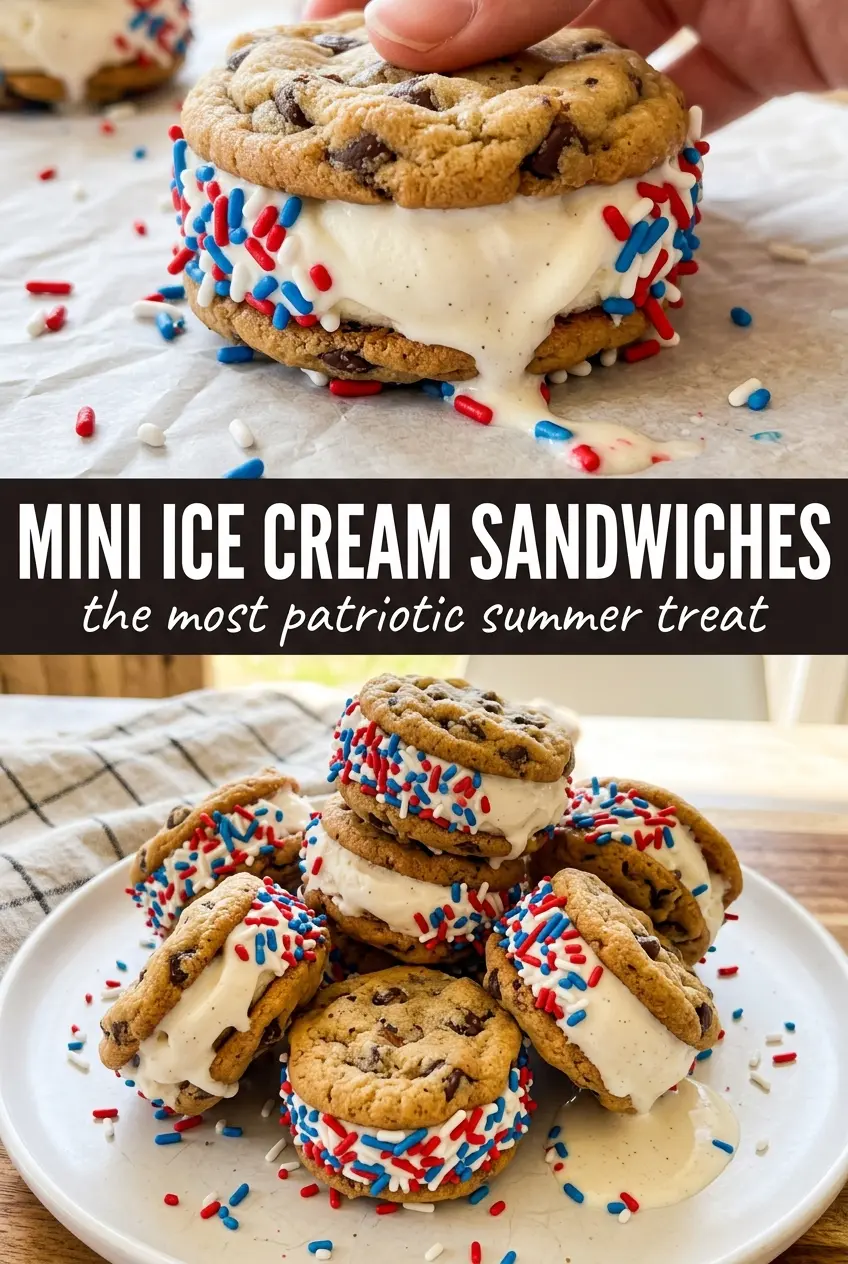
Mini ice cream sandwiches with red velvet cookies and a bright sprinkle rim are the kind of frozen dessert that disappear fast because they’re easy to eat, easy to hold, and built for a crowd. The cookie stays soft enough to bite cleanly after freezing, while the vanilla ice cream gives each sandwich that cool, creamy center people expect from a classic summer treat.
This version works because the cookies are baked just until set, not browned and dry. That keeps them flexible after freezing instead of turning brittle the minute they hit the freezer. The ice cream also needs to be softened just enough to scoop and press, but not melting into a puddle, or the sandwiches slide apart before the sprinkles have a chance to stick.
Below you’ll find the timing that matters most, plus the small freezer tricks that keep the sandwiches neat instead of lopsided. The sprinkle border looks festive, but it also gives you a clean handle on the edge of each sandwich.
The cookies stayed soft after freezing and the sprinkles stuck perfectly once I worked fast. My kids thought these were store-bought until I told them I made them the night before.
These patriotic mini ice cream sandwiches are the easiest way to make a red, white, and blue dessert that still feels homemade and neat enough to serve to a crowd.
Save these red, white, and blue mini ice cream sandwiches for your next Fourth of July dessert table
The part that keeps the sandwiches from falling apart in the freezer
The biggest mistake with homemade ice cream sandwiches is rushing the assembly while the cookies are still warm or the ice cream is too soft. Warm cookies melt the ice cream at the edges, and that melted layer turns slick before the sprinkles can adhere. Let the cookies cool completely, then give them a short freeze so they feel firm and stack neatly.
The other detail that matters is thickness. These cookies should bake into small, flat rounds with enough structure to hold a scoop but not so much height that they become hard to bite once frozen. A tablespoon-sized portion flattened to about 1/4 inch gives you that soft bite without the crumbling edge you get from thicker cookies.
- Red velvet cake mix — This gives the cookies a tender, bakery-style crumb with almost no effort. Chocolate cake mix works the same way if you want a deeper cocoa note and don’t care about the red color.
- Eggs and oil — These are what turn the mix into a soft dough that bakes into chewy cookies instead of cake domes. Don’t cut the oil too much; the cookies need that fat to stay flexible after freezing.
- Vanilla ice cream — A plain vanilla base keeps the cookies and sprinkles in charge. Use a full-fat ice cream if you can, since lighter versions can freeze icier and smear more during assembly.
- Red and blue sprinkles — Use jimmies or a fine sprinkle mix that will cling to the ice cream edge. Heavy nonpareils tend to roll off before the sandwiches freeze solid.
What Each Ingredient Is Actually Doing in This Recipe

- Primary ingredient (the star) — Quality matters most. Choose the best you can find.
- Cooking medium (oil, butter, or broth) — This carries flavors and prevents dryness.
- Seasonings (salt, pepper, spices, herbs) — Layer flavors so nothing overpowers. Build depth gradually.
- Aromatics (garlic, onion, herbs) — Cook with fat to bloom flavors. Become the foundation.
- Supporting ingredients — Complement the main ingredient without overpowering it.
- Sauce or liquid (if applicable) — Brings flavors together. Balance richness with acid.
- Acid (lemon, vinegar, wine, or other) — Brightens and prevents flat-tasting results.
- Final finish (garnish, glaze, or sauce) — Prevents one-dimensional taste and adds visual appeal.
Working quickly is what keeps the edges neat
Mixing the cookie dough
Stir the cake mix, eggs, and oil until a thick dough forms and no dry streaks remain. It will look more like a soft cookie dough than a batter, and that’s what you want. If it seems sticky, let it sit for a minute so the mix hydrates instead of adding extra flour. The dough should scoop cleanly and hold its shape when pressed.
Baking the mini cookies
Scoop tablespoon-sized portions onto parchment-lined sheets and flatten each one into a thin circle. Bake just until set at the edges and no longer glossy in the center, about 8 to 10 minutes. If they brown much, they’ll freeze hard and crack when you bite into the sandwich. Pull them early rather than late; they finish setting as they cool.
Cooling and freezing before assembly
Move the cookies to a wire rack and let them cool all the way through before freezing them for 30 minutes. That short chill makes the cookies easier to handle and helps the ice cream stay in place during assembly. If you skip this, the cookies flex too much under the pressure of the ice cream scoop and the sandwich starts sliding before you can wrap it. Keep the ice cream in the freezer until the last possible minute.
Filling, rolling, and wrapping
Work in small batches and sandwich a slightly softened scoop of vanilla ice cream between two frozen cookies. Press just enough for the ice cream to reach the edge, then roll that exposed rim through the sprinkles before the heat of your hands melts it. Wrap each sandwich tightly in plastic wrap and freeze until solid. The wrap keeps the cookies from drying out and stops freezer frost from dulling the sprinkle border.
How to change the cookies, ice cream, or sprinkle border without losing the point
Chocolate cookie version
Use chocolate cake mix instead of red velvet for a deeper cocoa flavor and a darker sandwich that still tastes festive. The process doesn’t change, but the red and blue sprinkles pop even more against the chocolate edge.
Dairy-free filling
Swap in a dairy-free vanilla ice cream with a dense, scoopable texture. Some nondairy brands soften faster than regular ice cream, so chill the sandwiches longer before serving or they’ll lean and smear at the edges.
Different sprinkles for a different holiday
Keep the cookie and filling the same, then switch the sprinkle colors to match whatever you’re serving. This is the easiest way to turn the same base recipe into a birthday dessert, school party treat, or holiday tray without changing the texture at all.
Smaller bite-size sandwiches
Make the cookies smaller and use a teaspoon-sized scoop of ice cream for tiny sandwich bites. They freeze faster and serve well for a big dessert table, though the sprinkle border is a little trickier because the ice cream edge is narrower.
Storage and Reheating
- Refrigerator: Not recommended. These soften too quickly and the cookies lose their clean bite within minutes.
- Freezer: Freeze wrapped sandwiches for up to 2 weeks for the best texture. After that, the cookies can pick up freezer flavor even when wrapped well.
- Reheating: No reheating needed. Let them sit at room temperature for 2 to 4 minutes before serving so the cookie softens just enough to bite without the ice cream collapsing.
Questions I Get Asked About This Recipe
Patriotic Mini Ice Cream Sandwiches
Ingredients
Equipment
Method
- Preheat the oven to 350°F and line baking sheets with parchment paper (visual cue: the pans are ready for dough right away).
- Mix the cake mix, eggs, and vegetable oil until a thick dough forms (visual cue: the mixture holds together and looks scoopable).
- Scoop tablespoon-sized balls onto the prepared baking sheets, flatten to about 1/4-inch thick circles, and bake for 8–10 minutes until set—do not overbake (visual cue: edges look set but the centers still appear tender).
- Let the cookies cool completely on a wire rack, then freeze for 30 minutes (visual cue: cookies feel firm to the touch before assembling).
- Working quickly, place a scoop of slightly softened vanilla ice cream on the flat side of one cookie and press another cookie on top to sandwich (visual cue: a thin layer of ice cream reaches the cookie edge).
- Roll the exposed ice cream edge in red and blue sprinkles (visual cue: the sides show a clear red-white-blue sprinkle border).
- Wrap each sandwich in plastic wrap and freeze for at least 2 hours until solid before serving (visual cue: sandwiches are fully firm and slice-stable when picked up).